
How to Search Hall County Court Records
Hall County court records use more than one search path. The official Hall County Online Docket is the front door for Superior Court, State Court, and Magistrate Court routing. It sends users to the Superior and State Courts case system for Clerk-managed cases and to Magistrate Court resources for civil filings, ordinance matters, deposit account fraud, warrants, and calendars. Probate files use Georgia Probate Records, especially for Hall County estate cases filed after 2010.
The online docket landing page warns that information is provided as is and that additional information remains available from the Clerk of Courts Office or Magistrate Court at the courthouse. That matters when a case is old, recently filed, sealed in part, or assigned to a city court. A search for Hall County Court cases should start online, then fall back to the exact office that keeps the file.
- Open the Hall County Online Docket and choose the correct court path.
- Use Superior and State Courts for felonies, divorce, State Court traffic, misdemeanors, and larger civil cases.
- Use Magistrate Court or Georgia Magistrate Records for Magistrate civil cases, ordinance violations, arrest warrants, and court calendars.
- Use Georgia Probate Records for estates, probate calendars, marriage application work, and related Probate Court filings.
- If the online result is missing or not enough, contact the Clerk, Magistrate Court, Probate Court, or Sheriff's Records Unit.
The manifest image captured from the Hall County Online Docket landing page shows why the first choice matters.
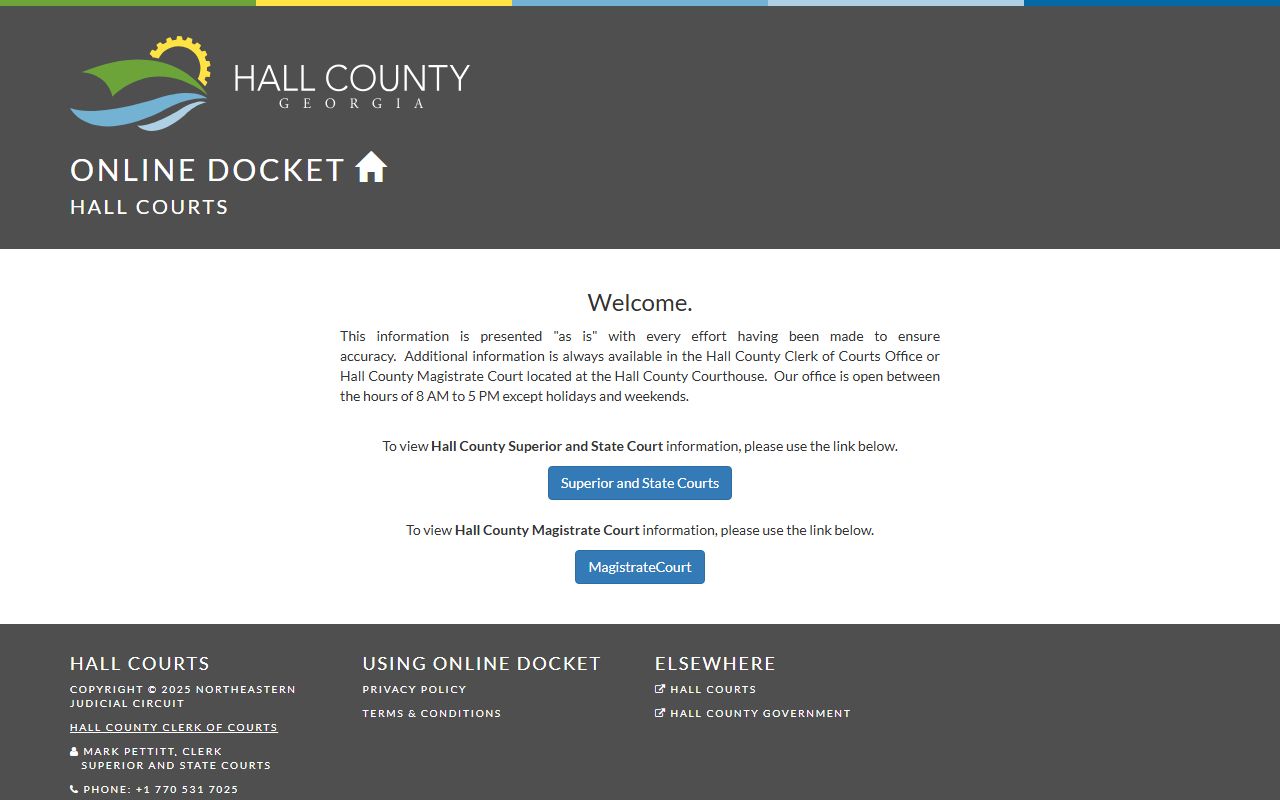
That routing page separates Superior and State Court searches from Magistrate Court searches before a user reaches the case data.
Hall County Court Search Fields
Magistrate civil search fields are the clearest public field inventory in the research. They show the type of identifiers a Hall County court records search may need: county, party names, file type, case number, and date ranges. Superior and State Court records use their own dynamic case-management path, so the Clerk remains the fallback for exact case copies or older files.
| Field Label | Type | Required | Notes |
|---|---|---|---|
| County | Dropdown | Yes | Select Hall County in the statewide Magistrate portal. |
| Last Name / First Name | Text | Optional | Used for party searches; each field accepts up to 50 characters. |
| File Type | Dropdown | Optional | Narrows Magistrate civil filing categories. |
| Case Number | Text | Optional | Best when the exact local case number is known. |
| File, Judgment, Disposition Dates | Date ranges | Optional | Date pickers use month, day, and year ranges. |
The county court and judicial services directory in the manifest comes from Hall County Court & Judicial Services.
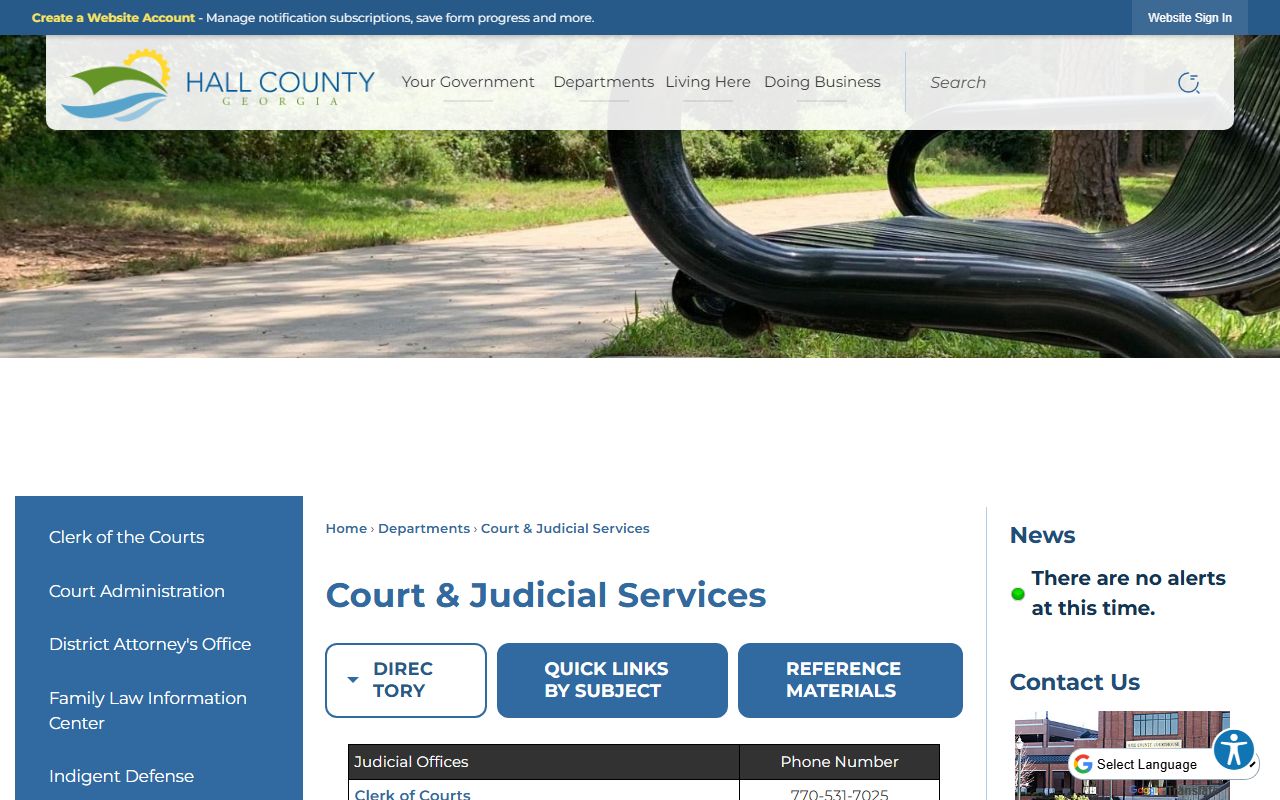
The directory gives the office phones that become important when a search field does not return the record.
Hall County Court System
Georgia does not use a county District Court model for Hall County. The primary trial court is Superior Court, and Hall County is in the Northeastern Judicial Circuit with Dawson County. Superior Court is the general jurisdiction court for felony criminal cases, divorce, land title, equity, and larger civil litigation. State Court handles many misdemeanors, traffic cases, and civil matters. Magistrate Court handles lower civil claims, ordinance matters, deposit account fraud, arrest warrant material, and public calendars.
Probate Court is separate at the courthouse annex. It handles estates, wills, guardianships, conservatorships, marriage licenses, weapons-carry licenses, and involuntary evaluation or treatment proceedings. Juvenile Court and municipal courts add more venues, but those records are not all public in the same way. Gainesville, Flowery Branch, Oakwood, Braselton, Buford, Gillsville, Lula, and Clermont can matter for city citations or local ordinance cases.
Case flow: Municipal or Magistrate filing > State Court or Superior Court when jurisdiction requires it > Court of Appeals of Georgia > Supreme Court of Georgia when the subject belongs there.
| Court | Record Role | Common Case Types |
|---|---|---|
| Superior Court | General trial court | Felonies, divorce, equity, land title, major civil cases |
| State Court | County trial court | Misdemeanors, traffic, civil cases within State Court jurisdiction |
| Magistrate Court | Lower court and warrant venue | Civil claims, ordinance fines, deposit account fraud, arrest warrants |
| Probate Court | Special court | Estates, guardianships, marriage licenses, weapons carry |
Types of Hall County Court Records
Hall County court records include civil complaints, answers, motions, judgments, garnishments, dispossessory filings, criminal cases, divorce files, probate files, traffic citations, and Magistrate calendars. A full court file can differ from the online docket. The docket is the chronological activity list, while the file may include pleadings, orders, signed judgments, sentence sheets, and certified copies available only through the proper clerk.
- Civil records: Superior, State, and Magistrate filings, including complaints, judgments, garnishments, and dispossessory actions.
- Criminal records: Felony and misdemeanor case files with charges, pleas, orders, dispositions, and sentence data.
- Family records: Divorce files, legitimation forms, and related Superior Court orders, with redactions when needed.
- Probate records: Estate, will, guardianship, conservatorship, marriage, and weapons-carry records held by Probate Court.
- Traffic records: Citation, court date, payment, plea, failure-to-appear, and state driver record consequences.
State e-access points users to provider websites, so county and court-specific routing remains part of a complete search.
What Hall County Court Records Show
A court record may show the case number, party names, court class, filing date, judgment date, disposition date, hearing type, bond, sentence, or financial entries. Criminal and warrant searches add charge data, offense dates, warrant numbers, and issue dates. Magistrate civil records include party and judgment information. Jail records can show current detainee name, primary charge, holding facility, and total bond, but those are Sheriff records rather than the full court case file.
| Field | What It Shows |
|---|---|
| Case Number | The local file identifier used by the portal or clerk. |
| Parties | Plaintiff, defendant, petitioner, respondent, or attorney names. |
| Docket | Chronological events such as hearings, filings, orders, and calendars. |
| Disposition | The outcome of a case or charge, such as judgment, dismissal, plea, or sentence. |
| Financial Data | Judgments, fines, bonds, fees, or traffic assessments when public. |
Hall County Court Public Access
Georgia public-record law gives a broad right to inspect and copy public records unless a specific law restricts access. For Hall County court records, that rule works with court sealing rules, clerk duties, and record restriction law. The practical path is direct: use the official court portal first, contact the keeper of the file next, and use the correct open-records channel for non-court agency records.
Key Statutes:
O.C.G.A. 50-18-70 states Georgia's strong public-record presumption.
O.C.G.A. 50-18-71 covers inspection, copying, timing, and fee rules.
O.C.G.A. 35-3-37 governs criminal-history record restriction.
Uniform Superior Court Rule 21 controls public access and sealing procedure for court records.
Hall County changed many general open-records requests to NextRequest on July 1, 2026, but courts, the Sheriff's Office, and Elections use separate routing. That exception is important. Court records should go through the Clerk, Magistrate Court, or Probate Court. Sheriff's incident, arrest, and jail materials should use the Sheriff's Records Supervisor or the Sheriff's online open-records form.
Restricted Hall County Court Records
Some Hall County court records are not open like ordinary civil docket entries. Juvenile cases, adoption files, mental health commitment proceedings, sealed criminal records, protected identifiers, and some guardianship or conservatorship materials may be limited by statute, court rule, or order. Hall Magistrate also states that only civil cases are available online because some criminal case information is sensitive.
Georgia uses the term record restriction for many criminal-history access limits. For arrests after July 1, 2013, the Georgia Bureau of Investigation says the person must contact the prosecutor rather than file a separate arresting-agency application. In Hall County that can involve the District Attorney, Solicitor-General, Sheriff's Office, and Clerk, depending on whether the record is an arrest report, a prosecution file, or a court disposition.
Hall County Sheriff and Jail Records
The Hall County Sheriff's Office operates the Hall County Jail at 1700 Barber Road in Gainesville. The Jail Bureau reports a 1,026-bed main facility, 148 work-release beds, and a house arrest program that manages up to 60 inmates daily. It also runs a warrant service unit that serves about 600 arrest warrants per month. Current jail lookup starts with the county inmate population page and the Police-to-Citizen inmate catalog.
The inmate list updates every 15 minutes, according to Hall County. A current detainee card can show name, primary charge, holding facility, and total bond. More detailed booking records, incident reports, or arrest reports are Sheriff records, not Clerk records, and should be requested from the Sheriff's Records Unit. The Justice Path Mobile App documented in the research is for court docket and jury information, not a Sheriff inmate app.
Hall County Marriage and Probate Records
Marriage licenses are issued by Hall County Probate Court, not the Superior Court Clerk. Both applicants must complete the online application through Georgia Probate Records before appearing together in person at Probate Court. Hall Probate requires government-issued photo identification with birth date, proof of prior marriage dissolution when applicable, and the exact premarital education certification form if a fee waiver is claimed.
Probate Court also handles wills, estates, guardianships, conservatorships, weapons-carry licenses, and involuntary evaluation or treatment proceedings. Most Hall County estate cases filed after 2010 are available through Georgia Probate Records, and probate calendars are available there as well. Divorce is different: the divorce decree is a Superior Court record requested through the Clerk, with Hall routing divorce decree questions to the appropriate Clerk division.
- Executor
- The person named or appointed to carry out estate administration.
- Conservatorship
- A probate case for management of another person's finances.
- Disposition
- The outcome of a case, petition, charge, or court request.
The manifest capture from Hall County communities helps show why city venue matters.
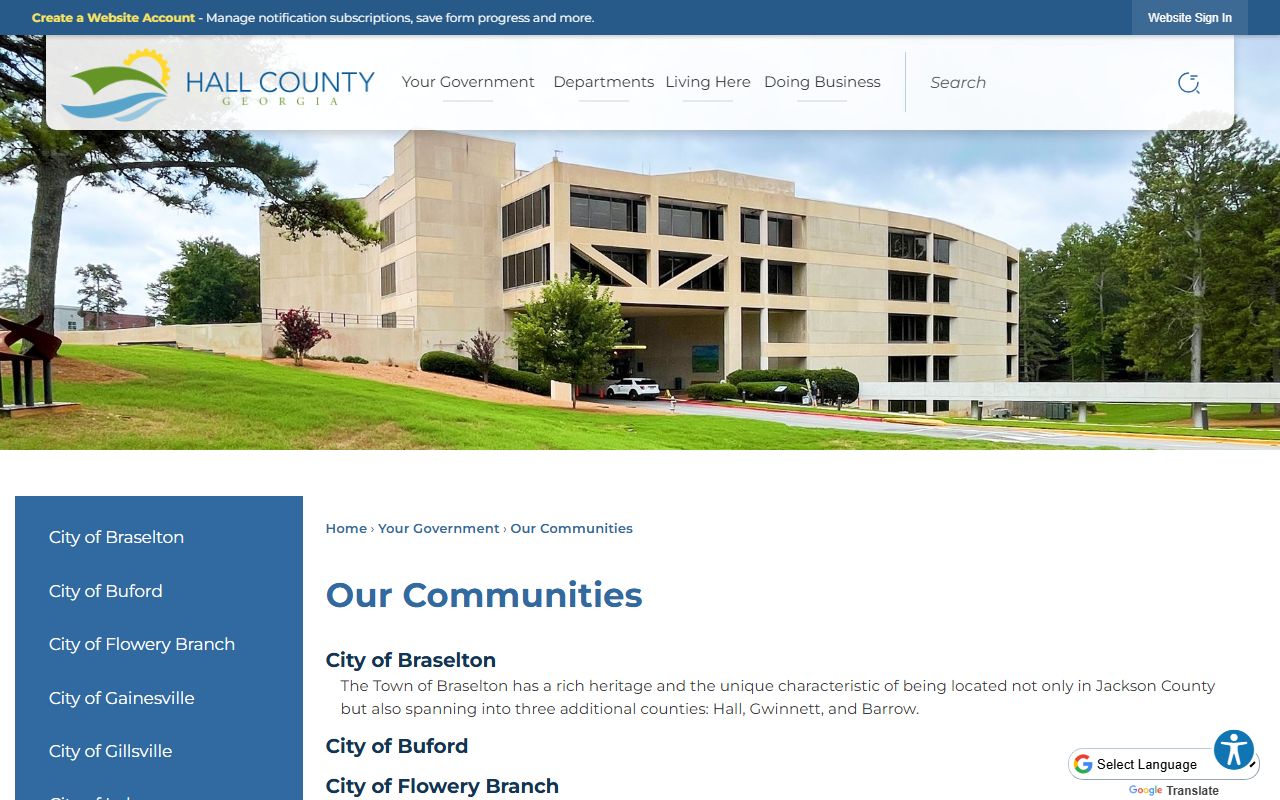
Some communities cross county lines, so a citation or city case should be checked by issuing court, not residence alone.
Hall County Traffic Court Records
Hall County traffic records are split by issuing court. County-level traffic and DNR citations route through the Hall County Clerk, Traffic Violation Bureau, Solicitor-General, and State Court process. Hall County lists traffic violations at 770-531-7065, and the Traffic Division FAQ says a person who cannot read a court date should call 770-531-7066 with the citation number.
Payment and court records are not the same as a Georgia DDS driver record. PayYourTix handles local payment for eligible citations, while DDS keeps driver history, points, license status, suspensions, and the separate Super Speeder assessment. Hall County traffic research says missing court adds $72.50 and may cause license suspension or a bench warrant. Super Speeder is a separate $200 state fine after qualifying speeding convictions.
| Record | Where It Lives | What It Shows |
|---|---|---|
| Court traffic record | Hall Clerk, State Court, municipal court, or issuing court | Citation, charge, court date, plea, fine, disposition, FTA |
| DDS driver record | Georgia Department of Driver Services | Convictions, points, license status, suspensions, Super Speeder effects |
Hall Area Transit appeared in the manifest from the official Gainesville transit page.
Transit planning can help users reach the downtown courthouse district, but exact route stops should be checked before travel.
Hall County Court Programs and History
Hall County has several accountability court programs in the Northeastern Judicial Circuit. Drug Court began in 2001 and has a minimum 24-month duration. The H.E.L.P. Program lasts 20 to 26 months and has five phases. Family Treatment Court began in 2006 for families affected by substance abuse, and Veterans Treatment Court links eligible veterans with local treatment resources. These programs can affect case supervision and outcomes, but they are not public search portals.
Federal court records for Hall County are separate. The Gainesville Division of the U.S. District Court for the Northern District of Georgia uses the Sidney O. Smith Federal Building & U.S. Courthouse at 121 Spring Street SE. Federal docket and document access runs through PACER and CM/ECF, not the Hall County Clerk. Bankruptcy cases use the U.S. Bankruptcy Court for the Northern District of Georgia.
Hall County courthouse history gives the records system local context. A log courthouse was built in 1818, a Gainesville Square courthouse burned in 1882, and an 1885 courthouse was destroyed in the 1936 tornado. A WPA-era courthouse and Gainesville City Hall followed in 1937. A modern county courthouse was completed in 2002.
The manifest image from Digital Library of Georgia preserves a local courthouse record.
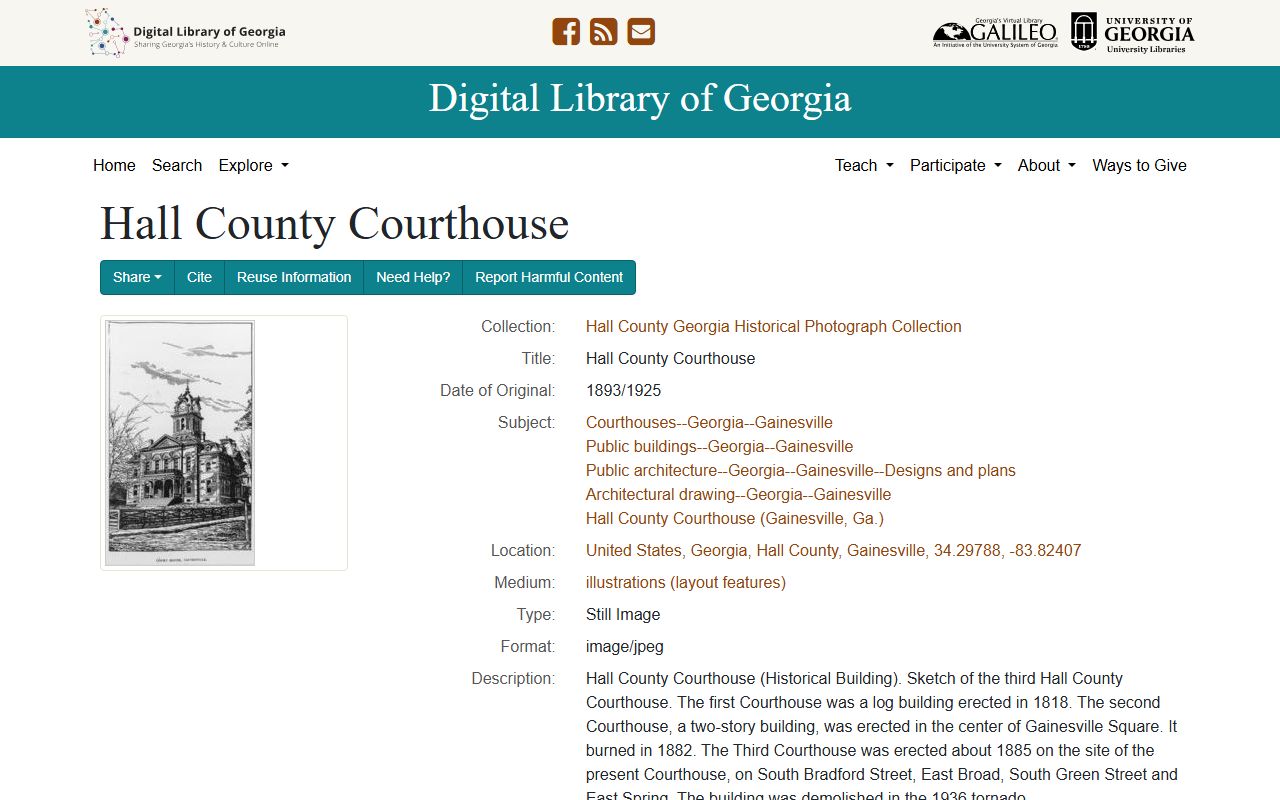
The archive helps connect today's courthouse block with Hall County's older courthouse sites and record history.
A second manifest image comes from Explore Georgia's historic Hall County Courthouse page.
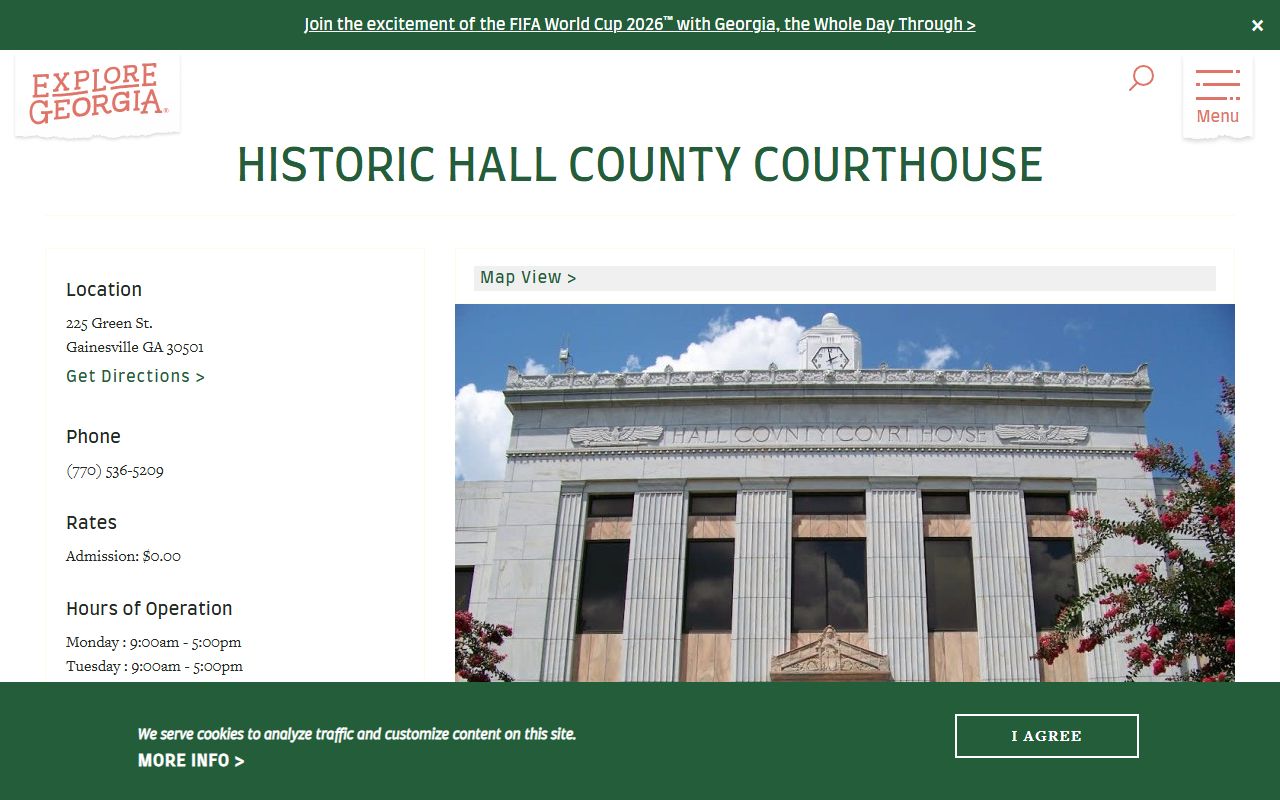
The historic courthouse remains a useful landmark near the modern court and government district.
The Northeastern Judicial Circuit also maintains public news, captured from the NEJC news page.
Recent NEJC news included judicial-complex town halls and electronic docket information through courthouse signage and Justice Path.
Hall County Court Contacts and Fees
Most Hall County record tasks are easier when the correct office is identified before a visit or phone call. The Clerk of Superior and State Courts is Mark Pettitt, and the Clerk office serves Superior and State Court records at the main courthouse. Probate Court has its own judge, associate judge, and chief clerk. Sheriff's records use a separate records process.
Hall County Courthouse
225 Green Street SE
Gainesville, GA 30501
770-531-7025
Monday-Friday, 8 a.m.-5 p.m.
Hall County Probate Court
116 Spring Street SE, 1st Floor
Gainesville, GA 30501
770-531-6921
Monday-Friday, 8:30 a.m.-4:30 p.m.
Hall County Jail
1700 Barber Road
Gainesville, GA 30507
770-531-6904
| Item | Amount or Rule |
|---|---|
| Marriage license | $56 statutory fee unless a valid premarital education waiver applies. |
| Probate e-filing | $14 TrueFiling convenience fee per petition or response, plus 3.25% card processing. |
| Sheriff open records | First 15 minutes no charge, then allowed search, retrieval, copying, redaction, and supervision costs. |
| Traffic failure to appear | $72.50 add-on, with possible license suspension or bench warrant. |
| Property bond | $20 non-refundable fee per criminal charge, cash only, exact amount. |
Note: Exact Clerk copy and certification fees were not located in the inspected official Clerk pages, so verify copy costs with the Clerk before ordering.
Hall County Court Records FAQ
Where does a Hall County court records search start? Start at the Hall County Online Docket. Use Superior and State Courts for Clerk-managed cases, Magistrate Court for Magistrate matters, and Georgia Probate Records for Probate Court files.
Are Hall County criminal records all online? No. Magistrate criminal information is limited online, and sealed, juvenile, adoption, and restricted criminal records may not be public.
Who keeps Hall County divorce records? Divorce is a Superior Court matter. Decrees and certified copies are requested through the Clerk of Superior and State Courts.
Are jail records the same as court records? No. Jail roster and booking materials are Sheriff records. The court file is kept by the court or clerk after a case is opened.